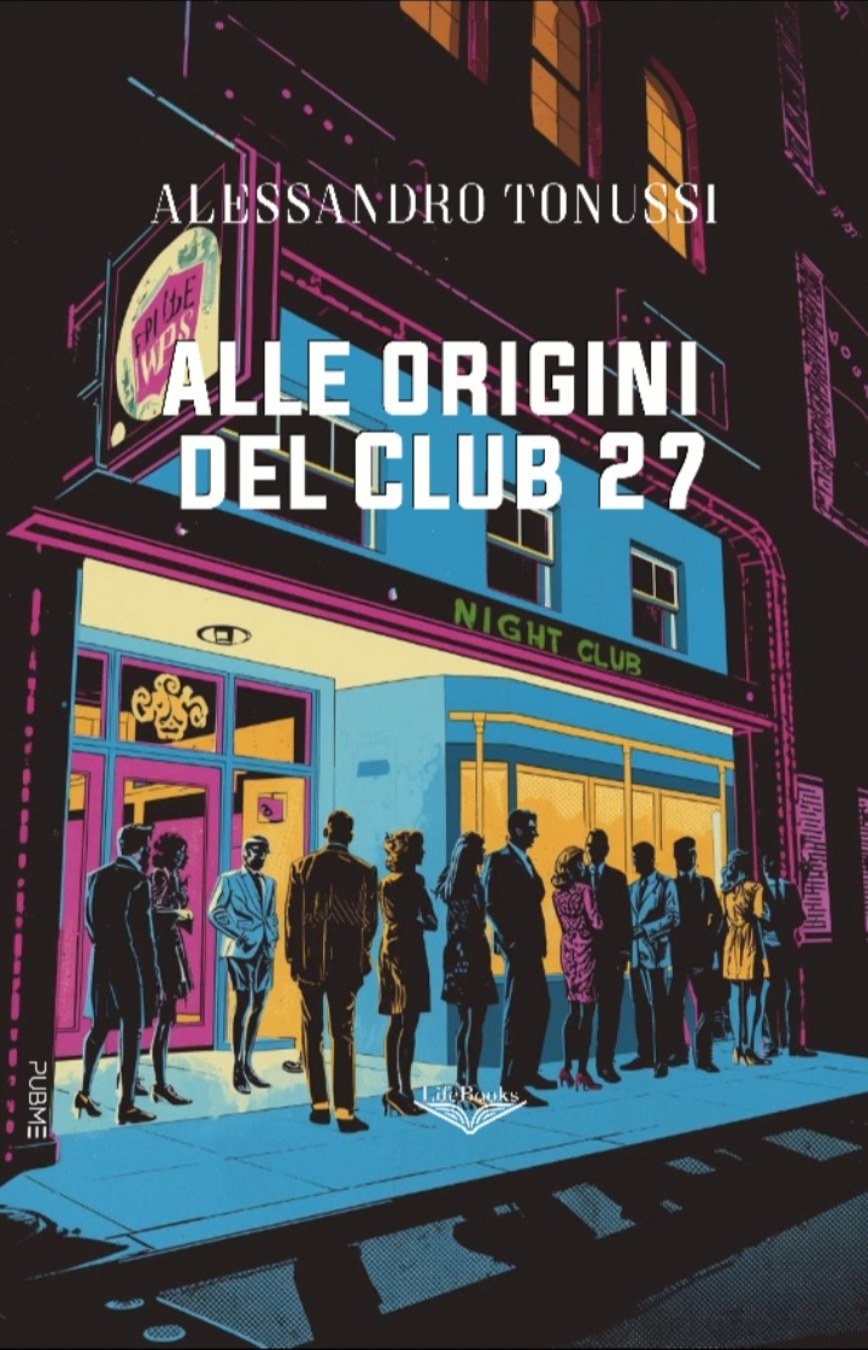
The Origins
of Club 27
Before Club 27 became a myth of rock culture, there were already ruptures, fears and unresolved questions. The novel starts from Altamont and crosses memory, violence, celebrity and destiny, without confusing narrative thesis with historical reconstruction.
When the myth begins before the legend.
The Origins of Club 27 uses the 1969 Altamont concert as its narrative rupture. It does not present it as a historical explanation of the deaths that would follow: it turns it into the symbolic place where the utopia of rock suddenly meets its own shadow.
From that crack the story moves toward some of the figures who made the number 27 indelible in collective memory. Biography, invention and musical culture brush against each other, but the centre remains one: understanding why certain deaths keep producing questions long after the music stopped playing live.
Club 27, then, is not treated as a magic formula or a theory to be proven. It becomes a narrative device for talking about success, fragility, the music industry, freedom and the price paid by a generation that became immortal too soon.
Four names. A memory that does not fade.
The novel crosses real artists without reducing them to decorative icons. Each carries a different crack within the myth of rock.
Aviano: when rock enters Friuli.
The story does not stay confined to the United States, London or Paris. In the novel, Aviano becomes a narrative bridge between the international myth of rock and Friuli Venezia Giulia: a concrete place where an apparently distant story changes scale and becomes territorial.
It is the same idea that runs through the author's work: places are not added to the plot as backdrops. They must have a function. They must change what happens.
Altamont
The cultural rupture from which the novel's narrative thesis begins: the dark side of a season that had promised freedom.
Aviano
The territorial passage that brings the great musical story into Friuli and ties the novel to the author's contemporary landscape.
With the patronage of the Jimi Hendrix Family Foundation.
The Origins of Club 27 has received the patronage of the Jimi Hendrix Family Foundation, linking the narrative project to the cultural memory of Jimi Hendrix and his artistic legacy.
A story designed to change language.
The Origins of Club 27 is also the starting point of a multi-platform path. The project extends into live performance and a possible audiovisual adaptation, currently in development and evaluation.
The principle remains the same: no inflated promises. The story comes first. Then, if the language changes, its cultural core, its relationship with the territory and the question that holds the whole novel together must stay intact.
Not a collective biography. A novel about the weight of myth.
It is written for those who love the history of rock but don't want yet another catalogue of dates, celebrity deaths and anecdotes. Here historical material becomes narrative matter, and Club 27 serves to question what happens when a real person is swallowed by their own symbol.
The number 27 is the hook. The real story is about memory, freedom, violence, solitude and the way we keep building legends around people who can no longer correct them.
From the novel to the stage and the screen.
On the site, the book remains the centre. Around it, the audiovisual project and cultural developments tell how a story can keep living without losing its identity.
Discover the audiovisual project